
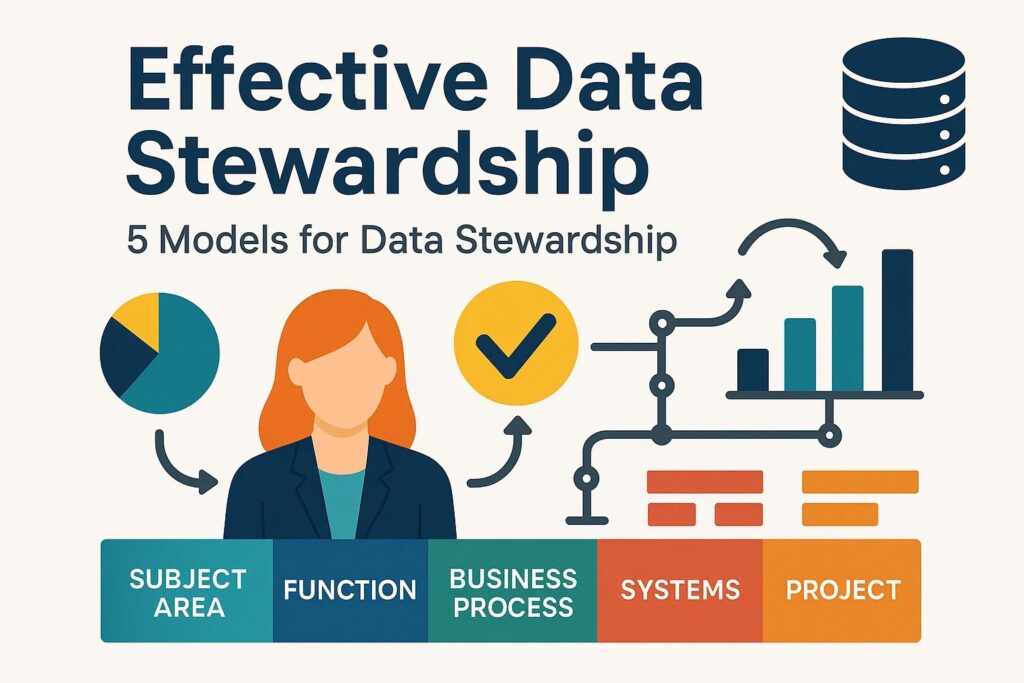
Effective data stewardship is crucial for organizations aiming to derive maximum value from their data. In their insightful white paper – 5 Models for Data Stewardship, Jill Dyché and Analise Polsky outline five distinct data stewardship models—Subject Area, Function, Business Process, Systems, and Project. Selecting the ideal model depends greatly on your organization’s size and the industry in which it operates. Below, I provide some recommendations to guide your choice.
Summary of the Five Models
- Subject Area Stewardship: Assigns data stewards based on specific data categories, such as customer or product data, clearly defining roles within data domains.
- Functional Stewardship: Aligns data stewardship responsibilities with distinct business departments or units, focusing on departmental data needs and expertise.
- Business Process Stewardship: Integrates data stewardship within specific enterprise processes, such as procurement or sales cycles, enhancing accountability and process-specific data quality.
- System-Based Stewardship: Focuses on stewardship at the source of data generation—operational and legacy systems—aiming for robust data quality from inception.
- Project-Based Stewardship: Introduces data stewardship quickly within specific projects to demonstrate immediate value and set the stage for broader stewardship practices.
Small Organizations
For small businesses with limited resources and simpler data environments, the Project-Based Data Stewardship (Model 5) is highly recommended. This model allows quick initiation, leveraging existing projects as platforms for introducing structured data management practices. It’s practical, doesn’t require dedicated long-term resources upfront, and provides immediate proof-of-concept value.
Ideal Industries:
- Startups (Technology, E-commerce)
- Small Professional Services firms
Medium-Sized Organizations
Medium-sized organizations typically benefit most from either the Subject Area or Function based stewardship models.
Subject Area Stewardship clearly defines roles and responsibilities across business-critical data categories like customer or product data, making it easy to implement in organizations that are structured around clear data domains.
Functional Stewardship works well when departments or business units distinctly handle their own data requirements and operational rules, fostering specialized expertise and business alignment.
Ideal Industries for Subject Area Model:
- Retail
- Manufacturing
- Healthcare (patient data, treatment information)
Ideal Industries for Functional Model:
- Financial Services
- Marketing and Advertising
- Media Companies
Large Enterprises
For large enterprises with complex processes, multiple departments, and numerous interconnected systems, choosing either the Business Process or System-Based stewardship models is advisable.
- Business Process Stewardship helps enterprises integrate stewardship seamlessly into well-defined enterprise processes such as “order-to-cash” or “procure-to-pay.” It emphasizes accountability and quality control within each significant business operation.
- System-Based Stewardship targets data quality at the source. This model is particularly effective in organizations heavily reliant on legacy and operational systems, enabling a robust, IT-driven stewardship that maintains consistent and high-quality data inputs.
Ideal Industries for Business Process Model:
- Pharmaceuticals (drug lifecycle management)
- Supply Chain and Logistics
- Telecom
Ideal Industries for System-Based Model:
- Banking (core banking systems)
- Insurance
- Government Agencies
Cross-Industry Considerations
Irrespective of the chosen model, successful implementation requires:
- Executive sponsorship to ensure stewardship initiatives are prioritized and integrated into organizational culture.
- Clearly defined metrics to assess the impact and efficiency of stewardship efforts.
- A formalized stewardship role rather than a temporary or secondary responsibility, ensuring dedicated focus and accountability.
Conclusion
Selecting the appropriate data stewardship model must align with your organizational maturity, size, industry-specific data challenges, and strategic objectives. Start small and scale stewardship efforts as your organization grows in complexity and data maturity. By carefully choosing and implementing the right stewardship model, you can significantly enhance your data’s value, improve compliance, reduce risks, and drive better business decisions.
