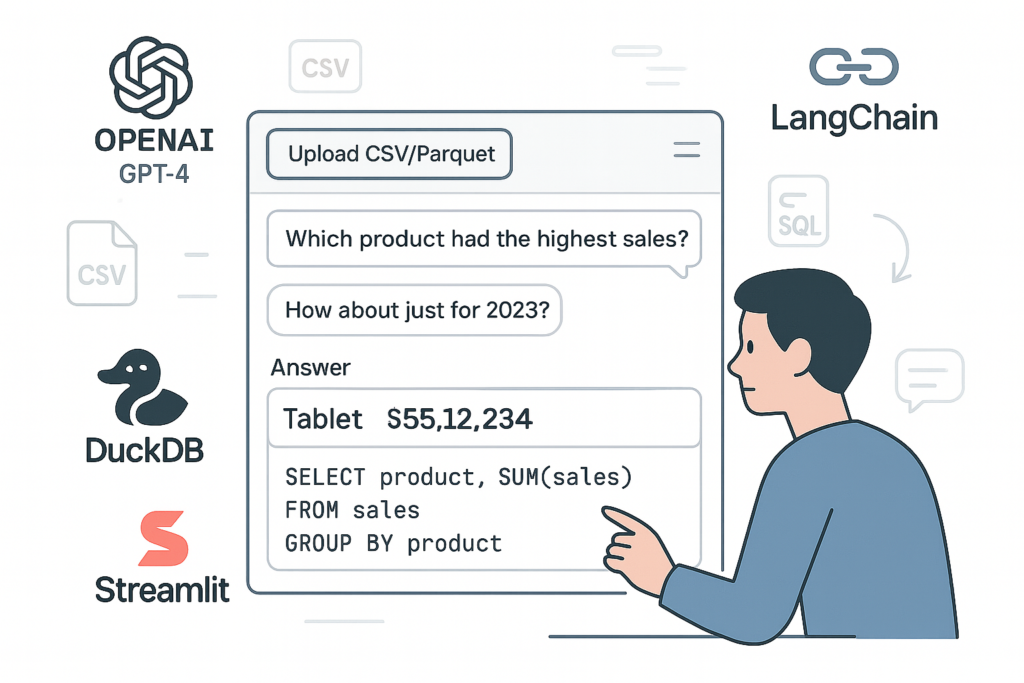
There’s a seductive idea circulating in enterprise IT right now: that you can build your own agentic AI layer using Copilot Studio, Azure AI Foundry, LangChain, or some cocktail of open-source tools and out-innovate the established platforms at a fraction of the cost. It’s compelling. It sounds like taking control.
Most of the time, it’s a trap.
But “most of the time” isn’t always. And the difference matters enormously depending on who you are, what you’re trying to automate, and how honestly you’ve assessed your own organizational readiness.
Let’s work through this carefully.
What We’re Actually Deciding
The question isn’t really “AI or no AI.” Every serious enterprise is moving toward agentic workflows. Systems that don’t just summarize a ticket but resolve it, don’t just draft an approval request but route it, execute it, and log it. The real question is architecture: do you let your platform vendor (ServiceNow, Salesforce, SAP, Microsoft) bring those capabilities to you natively, or do you build an orchestration layer yourself on top of a base-tier license?
Both paths have honest advocates. Both paths have significant failure rates. The decision hinges on five factors most organizations underweight.
The Case for Staying With the Platform
1. Your “legacy burden” is actually your moat.
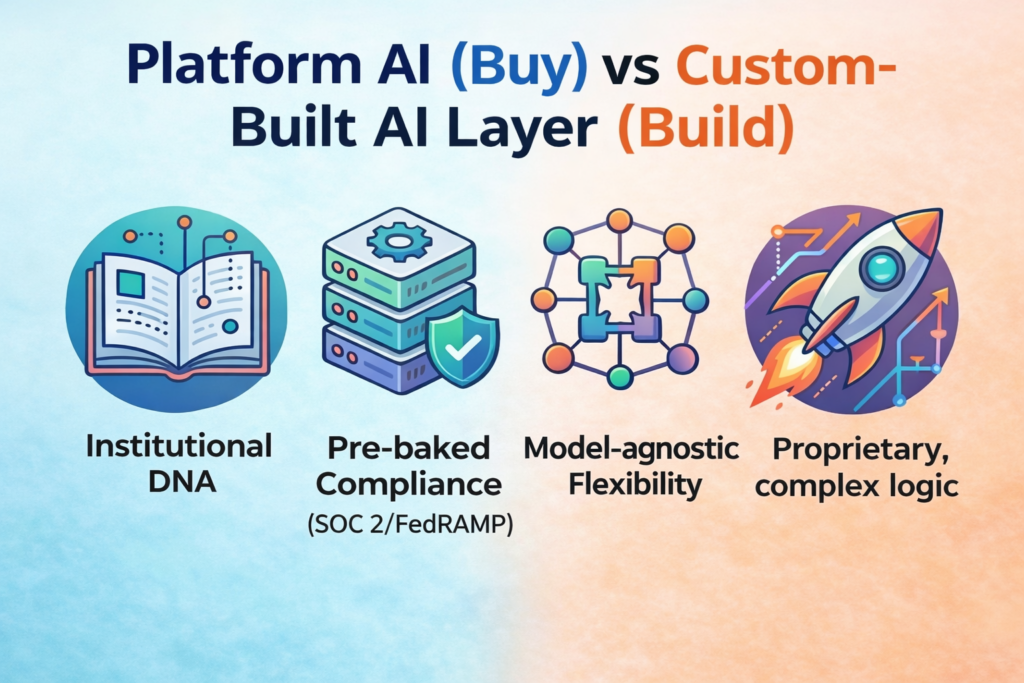
Enterprise platforms like ServiceNow, SAP, Salesforce aren’t just software, they’re the accumulated operational DNA of your company. Every custom business rule, every table, every workflow reflects a regulatory requirement, an audit finding, or an operational lesson learned the hard way. The CMDB isn’t just a database. It’s a map of your digital estate that took a decade to build.
When vendors like ServiceNow embed agentic AI natively through Now Assist, Agent Orchestrator, or their Anthropic partnership they’re not just adding a chatbot. They’re grounding AI reasoning in that context. The AI knows that the CMDB says this server is mission-critical. It knows this user’s role doesn’t permit certain access. It knows this change window is blacklisted.
A custom-built orchestration layer on top of a “mediocre” base platform doesn’t have that context. You have to rebuild it, often poorly and incompletely. That’s not a technology problem , it’s an organizational one, and it’s the primary reason 69% of AI projects never reach production.
2. Governance isn’t a feature. It’s the foundation.
For Multi Billion revenue organizations, manufacturers, financial institutions, energy companies, the risk calculus is asymmetric. A broken integration in a startup’s AI platform isn’t a helpdesk delay. It’s a potential production outage, a compliance breach, a GDPR violation.
Native platform AI comes with pre-vetted SOC 2 and FedRAMP controls, audit trails baked into every transaction, and guardrails like ServiceNow Guardian that monitor for prompt injection and biased outputs in real time. Building equivalent governance into a custom layer isn’t impossible but it’s underestimated by approximately an order of magnitude.
3. The per-seat math is brutal until it isn’t.
Native AI add-ons (Now Assist, Copilot for Microsoft 365, Salesforce Einstein) carry a real price premium: typically $50 to $100 per fulfiller per month, or a 25-50% uplift on your existing license. For a 500-fulfiller deployment, that’s $300,000 to $600,000 in incremental annual spend.
That sounds expensive. But toggle to the 2,500-fulfiller scenario. At enterprise scale, the per-seat model becomes crippling, and a well-executed custom build, expensive upfront, pays back aggressively by Year 2 or 3. The economics of “buy vs. build” aren’t universal. They depend entirely on your scale, your use case specificity, and your ability to actually ship.
The Case for Building Your Own
1. Platform AI is genuinely mediocre at complex, proprietary workflows.
Native AI tools excel at high-volume, relatively standardized tasks: incident summarization, knowledge article drafting, simple routing decisions. Where they fall flat is on queries that require deep cross-table reasoning “show me incidents where the assignment group bounced three times, there were concurrent change conflicts, and the affected CI is tied to a revenue-generating service.” That kind of query needs custom logic that no out-of-the-box AI has been trained to handle well for your specific environment.
If your competitive advantage lives in complex, proprietary operational workflows then native AI will underserve you, regardless of the vendor’s marketing claims.
2. You avoid extreme vendor lock-in on AI capabilities.
When you adopt a platform’s native AI, you’re betting that the vendor will remain the best AI provider indefinitely. That’s a losing bet. The model landscape is moving too fast. ServiceNow’s partnership with Anthropic is smart, but what happens in two years when a different model dramatically outperforms Claude on your specific use cases?
A custom orchestration layer, using Azure AI Foundry, AWS Bedrock, or an open-source framework lets you swap models without re-architecting your entire service management stack. You become model-agnostic. For organizations with significant AI budgets and mature engineering teams, that flexibility has compounding value.
3. The Copilot Studio / Azure AI Foundry middle path is real.
Microsoft has done something genuinely interesting with Copilot Studio: it gives organizations a relatively low-code way to build custom agentic workflows that sit on top of their Microsoft 365 and Dynamics investments without fully rebuilding on a greenfield platform. Combined with Azure AI Foundry’s model access and Power Automate’s integration breadth, this ecosystem represents a credible “build” option that is substantially less risky than a pure custom code approach.
This path isn’t for everyone, it’s best suited for organizations already deeply invested in the Microsoft stack, with processes that live primarily in M365, Teams, and Dynamics. But for those organizations, it offers a meaningful alternative to paying the ServiceNow or Salesforce AI premium.
The Framework: How to Actually Decide
Rather than making a binary choice, think in terms of three zones:
Zone 1 — Use native platform AI: High-volume, standardized, cross-functional processes where governance and integration complexity are the primary risks. Password resets, standard onboarding, incident routing, knowledge retrieval. Start here regardless of what you decide to do elsewhere. The ROI is fast, the risk is low, and it builds internal trust in AI.
Zone 2 — Build a custom agentic layer: Proprietary workflows with unique business logic that give you competitive differentiation. Processes where the AI needs to reason across your specific data model in ways no vendor has pre-built. Complex cross-domain orchestration involving OT/IT convergence or highly regulated decision flows. Only enter this zone if you have AI/ML talent to sustain it and not just to build it.
Zone 3 — Don’t touch yet: High-stakes autonomous decisions (HR conflict resolution, security access grants, financial approvals) where the liability exposure exceeds the automation benefit. Human-in-the-loop governance isn’t a limitation here , it’s the right answer.
The Trap Most Organizations Fall Into
The failure mode isn’t choosing the wrong path. It’s choosing both paths simultaneously, without commitment to either.
Organizations that buy full native AI licenses at contract signing, before piloting, before proving value, end up with shelfware. Organizations that greenlight a custom build without a genuine assessment of their data quality, integration complexity, and AI talent end up with a platform sprawl crisis six months later, having spent millions wiring together vector databases, telephony APIs, and LLMs into something brittle and ungovernable.
The tactical recommendation that survives almost every enterprise context: resist buying full-fulfiller AI licenses upfront. Negotiate phased pricing. Pilot with 50 to 100 users. Prove containment rates and MTTR reduction before scaling. Document that ROI and then decide how much more to buy or whether to build.
The Bottom Line
ServiceNow’s “inverse moat”, the fact that it’s deeply embedded, occasionally clunky, and expensive to exit is also the reason it remains the execution engine of choice for the world’s largest organizations as agentic AI matures. The AI adds the reasoning. The platform provides the trust layer.
But for organizations at genuine enterprise scale with proprietary workflows and the engineering capacity to sustain custom development, the build case is real and the economics eventually favor it.
The right answer isn’t ideological. It’s a spreadsheet, a capability assessment, and an honest conversation about what your organization can actually ship and govern. Start with that. Everything else follows.