Pickleball is sweeping Illinois, with participation soaring from 4 million players nationwide in 2020 to 13.6 million in 2023. As a data‑analytics professional (and avid player), I was curious where is the sport thriving most in my state – Illinois? Using DUPR – the Dynamic Universal Pickleball Rating system – as my source, I analyzed over 12,000 Illinois players to understand where pickleball is thriving, and why some suburbs are outpacing Chicago.
Why use DUPR?
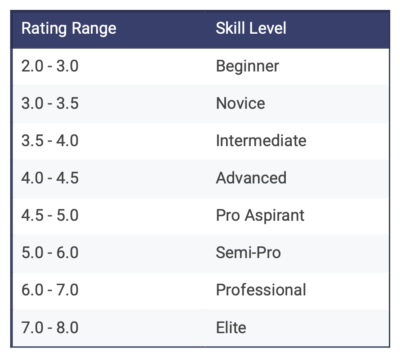
The Dynamic Universal Pickleball Rating (DUPR) platform is currently the most popular rating system in the sport . DUPR’s strength lies in its global reach and data quality – players of all ages and genders are rated on the same 2.000 – 8.000 scale . The platform is widely adopted by recreational players and professionals alike, providing a common language for skill level. Because DUPR is integrated with most tournament and club software , the data provides a high‑resolution picture of pickleball participation. Recreational players use the app to find opponents at their level and track progress, so the data captures a broad cross‑section of the community. Below is a summarized table of the DUPR rating system
Methodology
To examine pickleball participation across Illinois, I built a scraper using selenium with chrome webdriver that queried DUPR’s public search. DUPR’s search allows users to find players within a 100‑mile radius of a city. By iterating through major cities and suburbs (Chicago, Naperville, Rockford, Champaign and others), I harvested player records and combined them into a single dataset. After cleaning duplicates and verifying locations, the final dataset contained 12 ,307 players (8 105 rated players and 4 202 unrated or “NR” players). I analyzed the data with Python and visualized it using Folium and the Illinois census shapefile to map player densities.
State-wide Summary
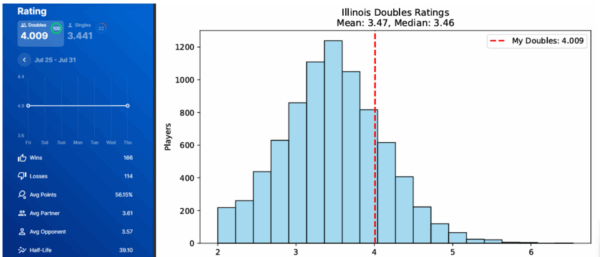
At the statewide level, Illinois’ DUPR data confirms the sport’s broad appeal. The average doubles rating among rated players is 3.47 with a median of 3.46, placing most Illinois players squarely in the intermediate category. The gender split shows about 65 % male and 35 % female participation, and the median age is around 48 years (with women tending to be slightly older than men).
Top cities – Naperville dominates
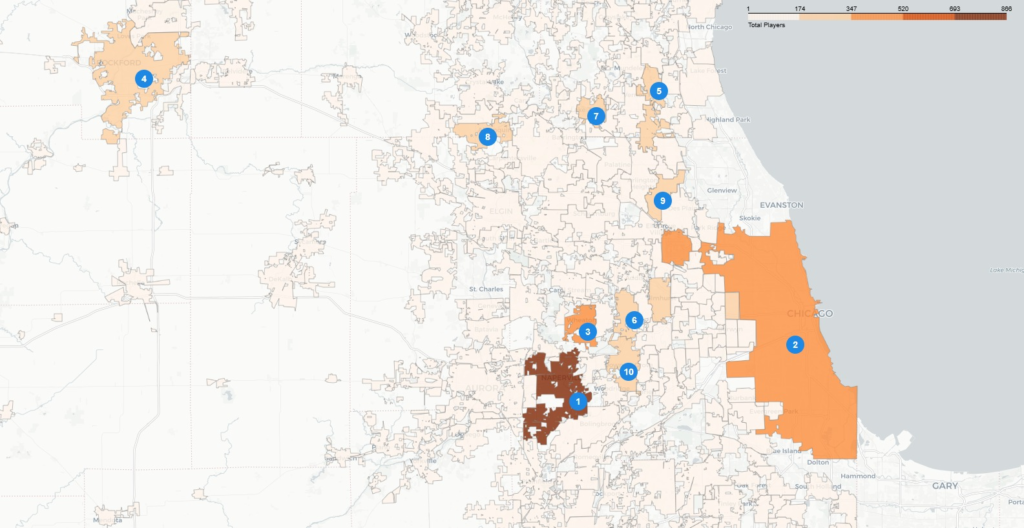
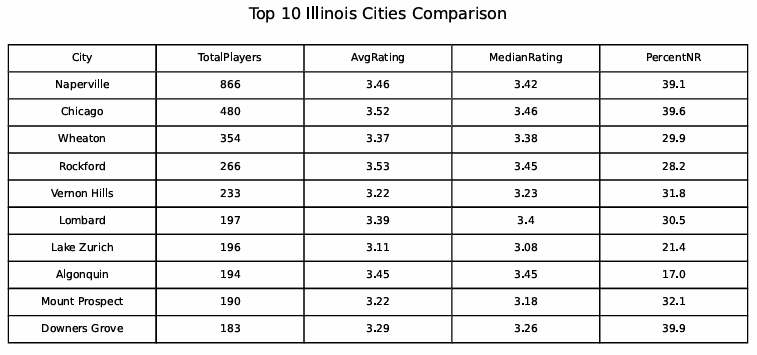
Aggregating players by city reveals that Chicago is not the epicenter of Illinois pickleball. The suburb of Naperville has 866 players, nearly 80 % more than Chicago’s 480. Wheaton, Rockford, Vernon Hills and Lombard follow (full table below). Naperville also has a remarkably active competitive scene: despite having slightly lower average and median ratings than Chicago, its sheer number of players and clubs sets it apart.
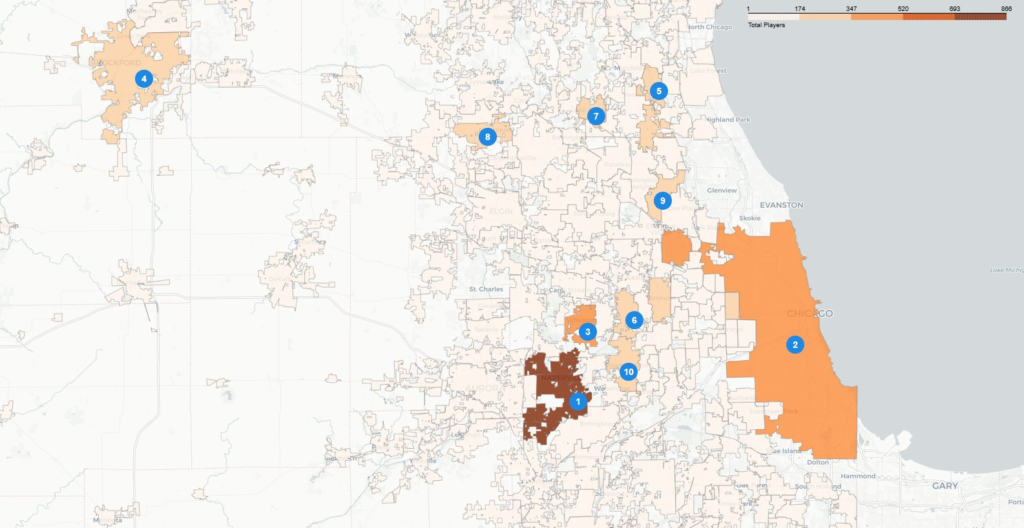
Naperville vs. Chicago – reasons for the gap
Court supply and infrastructure. According to the Chicago Park District, the city has roughly 80 pickleball courts at over 40 parks in 2022, but only four of those were dedicated pickleball courts; the rest were shared tennis courts . To address the shortage, the district launched its “Pickleball Mania” programme to build 50 new courts by 2025 . Even so, local players note that Chicago’s courts are often overcrowded; many matches are restricted to a few morning hours and “wait lists” are common . A 2024 update shows that the goal has expanded to 200 courts by 2025, with nearly 100 either open or under construction . Nevertheless, court scarcity has delayed major tournaments – the 2022 APP Chicago Open was held in suburban Highland Park because Chicago lacked adequate facilities . Naperville’s infrastructure is the opposite. The city has 57 pickleball courts – 37 indoor and 20 outdoor providing year‑round playing options . The Naperville Convention & Visitors Bureau describes the city as a “pickleball paradise,” noting that players can choose among indoor clubs like The Picklr (9 courts), Sure Shot Pickleball and Play N Thrive, each with 11 courts . The Naperville Park District proudly markets pickleball as “one of the fastest‑growing sports” and offers programs for juniors through seniors . By 2025, even more capacity is on the way; local entrepreneurs are opening a franchise of Pickleball Kingdom, promising climate‑controlled indoor courts, coaching and leagues . A news report notes that this will be Naperville’s third major indoor facility, joining The Picklr and Sure Shot .
Community culture: Naperville’s pickleball community is described as welcoming and vibrant. The Visit Naperville blog emphasises that players of all levels can join friendly matches, organised leagues and an annual All‑City tournament; the camaraderie is “unmatched” . The city’s park district offers lessons and clinics run by dedicated coaches , making it easy for newcomers to learn the game. In Chicago, by contrast, players often rely on grassroots groups to paint temporary lines on tennis courts and lobby for space. While the city is improving, the fragmented infrastructure has slowed community development.
Suburban space and demographics: The difference also reflects broader demographic and geographic factors. Naperville is a sprawling suburb with ample land for recreation and a high median household income. Private clubs can invest in purpose‑built indoor facilities that charge membership fees, while public parks supplement with free outdoor courts. Chicago’s dense urban environment leaves less room for large complexes. The city’s court expansion plans involve converting basketball or tennis courts , which can create conflicts with other sports. Additionally, Naperville’s population skews toward families and active adults, demographics often associated with pickleball adoption.
Where I Stand
As both a player and Data Analytics professional, I couldn’t resist turning the lens on my own performance. With a DUPR doubles rating of 4.009 as of 7/31/2025, I currently rank in the top 19.9% of rated players in Illinois and in the top 24.7% among men. Within my age group (40–45), I place in the top 25.6% statewide. My rated match record stands at 166 wins and 114 losses, with an average point share of 56.15%, showing consistent competitiveness. While I’m proud of this progress, what excites me most is the growing depth and breadth of talent across Illinois. Whether on the court in Naperville or Chicago, or behind the screen analyzing trends, it’s clear we’re only in the opening chapters of pickleball’s story here.